2026 Top Soup Kettles for Global Buyers
For global foodservice buyers, selecting the right Soup Kettles requires more than comparing prices. Capacity, heating control, construction, and after-sales support all affect daily performance. A 20-liter kettle may suit a small café, while a hospital kitchen may need a 100-liter jacketed model. The difference becomes clear during a busy lunch service.
Thomas Keller, a respected chef and culinary authority, once said, “A recipe has no soul. You, as the cook, must bring soul to the recipe.” His point also applies to commercial equipment. A reliable kettle should support consistent cooking without distracting staff. Even heat distribution matters when preparing creamy mushroom soup, lentil stew, or delicate seafood broth. Stainless steel interiors, insulated handles, accurate thermostats, and easy-drain valves can improve both safety and workflow.
This guide reviews the 2026 Soup Kettles market for international buyers. It considers electric, gas, countertop, tilting, and stationary designs. It also examines voltage compatibility, food-contact materials, cleaning access, packaging, warranty terms, and spare-part availability. These details are easy to overlook.
No ranking is perfect.
Some buyers may value automation more than capacity. Others may prefer simpler controls because local technicians understand them better. We also recognize that product data can change between suppliers and regions. Therefore, buyers should verify certifications, installation requirements, and service coverage before ordering. The strongest choice is not always the most advanced model. It is the kettle that matches the menu, kitchen space, staff skills, and expected production volume.
Soup Kettle Types and 2026 Global Buyer Market Segments
In 2026, soup kettles will serve several buyer segments, not one uniform market.
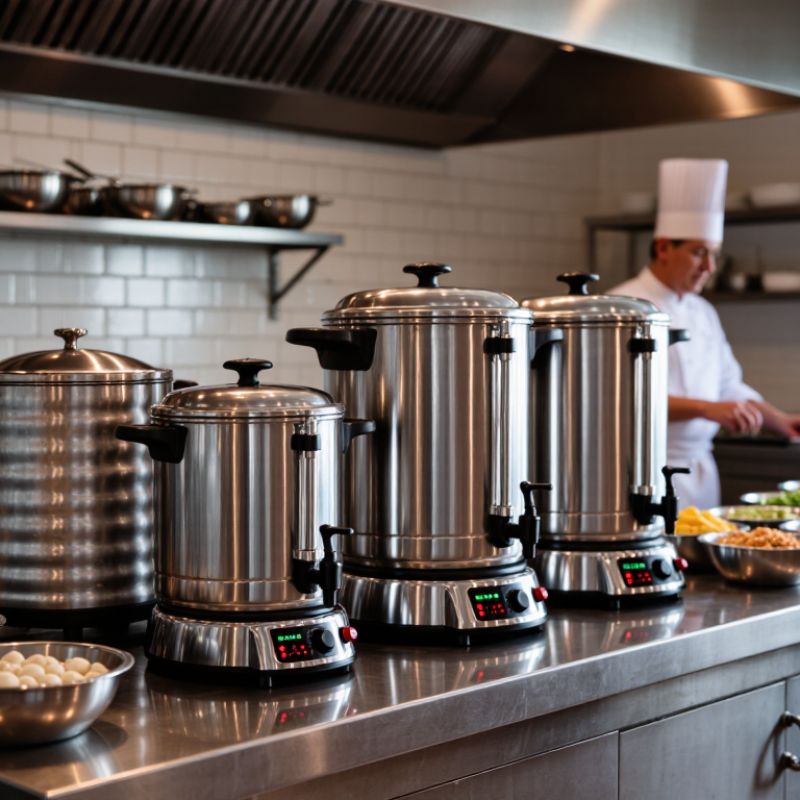
Commercial cooking equipment was valued at about USD 13.2 billion in 2022 and may grow at over 5% annually through 2030, according to Grand View Research. That growth supports demand for compact countertop kettles, wet-well warmers, induction units, and larger tilting models. Each type fits a different workflow. A café may need a 6-liter electric kettle beside the service counter. A hospital kitchen may require stainless-steel construction, precise holding temperatures, and easy cleaning.
Hospitality buyers often prioritize appearance, noise control, and flexible batch sizes. Institutional buyers usually focus on durability, food-safety procedures, and maintenance access. Catering operators need lighter equipment, stable lids, and compatibility with changing power supplies. The global commercial kitchen equipment market could reach approximately USD 112 billion by 2028, according to Fortune Business Insights, but regional infrastructure still affects purchasing decisions. A 220-volt model is unsuitable for some facilities without electrical upgrades. That detail is easy to overlook.
Distributors and private-label importers should compare insulation, thermostat recovery time, pan capacity, and spare-part availability. Energy performance also deserves attention. The U.S. Department of Energy reports that commercial cooking equipment can represent a meaningful share of foodservice energy use, although exact savings vary by operation. Buyers should request test methods, not vague efficiency claims. My practical concern is simple: larger capacity does not always mean better value. A kettle that holds too much soup may create waste, uneven turnover, and unnecessary cleaning work.
Capacity and Batch Sizing: Common 6–40 L Commercial Kettles
Capacity and Batch Sizing: Common 6–40 L Commercial Kettles
Commercial soup kettles usually range from 6 to 40 liters, covering cafés, hospitals, catering kitchens, and small production rooms. A 6–10 L kettle suits 20–35 portions when serving 250–300 ml bowls. A 20 L unit can produce roughly 65–80 portions, depending on recipe density and safe working volume. Do not fill to the rim. Leave space for stirring and expansion.
The FDA Food Code 2022 recommends holding hot food at 57°C (135°F) or above. Its cooling guidance requires food to fall from 57°C to 21°C within two hours, then reach 5°C within six hours. These limits make batch sizing a safety decision, not only a purchasing decision. Smaller batches often cool more predictably. They also reduce leftovers during quiet service periods. The U.S. National Restaurant Association’s 2025 industry outlook highlights continued pressure on labor and operating costs, making repeatable batch production increasingly important.
A useful calculation starts with peak demand, not kettle volume. Multiply expected portions by serving size, then add 10–15% for spillage and replenishment. A 40 L kettle may appear efficient, but it can create waste when demand changes hourly. This is where planning becomes imperfect. Track actual ladle counts for two weeks, compare them with sales records, and adjust the next purchase. Always verify the manufacturer’s working capacity, heating recovery time, and cleaning access before ordering.
2026 Top Soup Kettles for Global Buyers - Capacity and Batch Sizing: Common 6–40 L Commercial Kettles
Typical commercial specifications for planning batch size, kitchen space, power supply, and service volume
| Nominal Capacity | Recommended Working Fill | Approx. Servings
(250 ml each) | Typical Heating Input | Typical Heating Time
(20°C to 90°C) | Typical External Size
(W × D × H) | Common Heating Method | Best-Fit Operation | Batch Planning Guidance |
| 6 L | 4.5–5 L | 18–20 | 1.0–1.5 kW | 35–50 minutes | 390 × 390 × 420 mm | Electric direct heat | Small cafés, tasting counters, hotel breakfast stations | Suitable for several small refills rather than one large service batch. |
| 10 L | 7.5–8.5 L | 30–34 | 1.5–2.0 kW | 35–50 minutes | 430 × 430 × 470 mm | Electric direct heat or bain-marie | Cafés, delicatessens, self-service counters | Provides a practical balance between countertop footprint and daily menu variety. |
| 15 L | 11–13 L | 44–52 | 2.0–2.5 kW | 40–55 minutes | 470 × 470 × 520 mm | Electric bain-marie or direct heat | Busy cafés, canteens, buffet service | Allows a medium batch while retaining headspace for stirring and movement during service. |
| 20 L | 15–17 L | 60–68 | 2.5–3.0 kW | 45–60 minutes | 520 × 520 × 570 mm | Electric bain-marie or direct heat | Institutional kitchens, restaurants, medium buffets | Often suited to one main lunch or dinner service with moderate demand. |
| 25 L | 19–21 L | 76–84 | 3.0–3.5 kW | 50–65 minutes | 560 × 560 × 610 mm | Electric bain-marie or jacketed heating | Hotels, schools, hospitals, catering kitchens | Useful where batch consistency and longer holding periods are more important than mobility. |
| 30 L | 23–25 L | 92–100 | 3.0–4.0 kW | 55–70 minutes | 600 × 600 × 660 mm | Electric jacketed or bain-marie heating | High-volume restaurants, central kitchen sections | Plan for adequate ventilation, floor clearance, and a dedicated electrical circuit where required. |
| 40 L | 30–34 L | 120–136 | 4.0–6.0 kW | 60–80 minutes | 670 × 670 × 730 mm | Electric jacketed, steam-jacketed, or gas-assisted heating | Large catering operations, institutional food production | Best for scheduled production batches; confirm power, drainage, access width, and lifting requirements before purchase. |
Planning note: Working fill is generally kept below nominal capacity to reduce splashing and allow safe stirring. Heating times are indicative ranges for liquid soup under normal ambient conditions and vary with starting temperature, recipe thickness, vessel material, lid use, and supply voltage. Actual dimensions and electrical requirements should be confirmed against the final product specification.
Heating Systems Compared: Gas, Electric, and 3–6 kW Induction Models
2026 Top Soup Kettles for Global Buyers
Heating Systems Compared: Gas, Electric, and 3–6 kW Induction Models
For global buyers, soup kettles should be compared by heat control, installation, and service access. Gas models heat quickly and remain useful where fuel infrastructure is dependable. They suit high-volume kitchens with strong ventilation and trained operators. However, flame exposure adds cleaning demands and ventilation costs. A stable pilot and clear pressure data matter more than headline output.
Electric kettles offer simpler installation and steady heat for hotels, schools, and compact production rooms. They usually need less ventilation, but recovery can slow after large cold batches. Check voltage, phase, plug design, and circuit capacity before ordering. A qualified technician should confirm local electrical requirements. Induction models from 3 to 6 kW respond quickly and waste less heat around the vessel. A 3 kW unit fits lighter service; 6 kW supports faster recovery. Yet induction requires compatible cookware and careful electrical planning.
On-site trials are valuable. Measure warm-up time, simmer stability, noise, and energy use with real recipes. A thick soup may behave differently from clear broth. Ask about insulation, drain placement, temperature sensors, and replacement parts. I would not rank gas, electric, or induction universally. The best choice depends on energy prices, kitchen layout, duty cycle, and maintenance skill. Some comparisons ignore downtime; that is a costly blind spot.
2026 Top Soup Kettles for Global Buyers
Heating Systems Compared: Gas, Electric, and 3–6 kW Induction Models
The chart compares representative rated heating input for commercial soup-kettle configurations. Gas input is shown as approximately 8.8 kW, equivalent to 30,000 BTU/h, while electric and induction models are commonly available at 3 kW and 6 kW ratings. Higher input can support faster heating, but actual performance also depends on kettle capacity, insulation, controls, cookware compatibility, and local electrical or gas regulations.
Food Safety Benchmarks: HACCP 60°C Hot Holding and NSF/ANSI 4
For global buyers, soup kettles should be judged by food safety performance, not capacity alone. Many HACCP plans specify 60°C (140°F) for hot holding. However, the U.S. FDA Food Code 2022 lists 57°C (135°F) as the minimum hot-holding temperature. The 60°C benchmark therefore gives operators a practical safety margin during service.
Temperature stability matters inside every kettle. A unit may display 60°C while the surface cools near the rim. Buyers should request test records from multiple points, including the center, wall, and outlet area. The U.S. FDA Food Code 2022 also supports temperature control during storage and service, while time limits remain important. Heat alone cannot correct poor handling.
NSF/ANSI 4 evaluates commercial cooking and hot-food equipment for hygienic design, cleanability, materials, and operating performance. Look for smooth welds, drainable interiors, protected controls, and removable parts. Ask for certification scope, not just a printed logo. Small details matter. A blocked drain or difficult seal can undermine an otherwise compliant HACCP process. Specifications can still be imperfect, so buyers should verify performance under real loads, stirring patterns, and local voltage conditions.