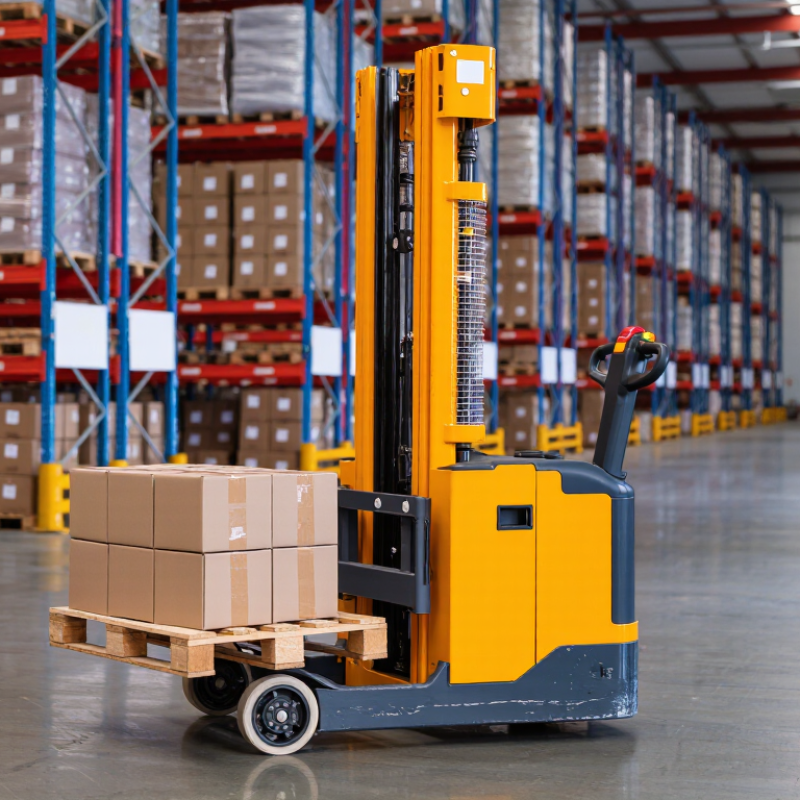
| 1. Application and Performance |
| Rated load capacity | Approximately 1,000–2,000 kg for common pedestrian high-lift pallet trucks | Capacity decreases when the load center is farther from the forks or when the forks are raised higher. | Choose a rated capacity above the heaviest planned load and verify the capacity chart at the required lift height. |
| Lift height | Approximately 0.8–3.5 m, depending on mast configuration | Higher lift heights improve access to raised storage but can reduce residual capacity and increase mast deflection. | Match the maximum lift height to the highest storage level, allowing clearance above the pallet and rack beam. |
| Travel speed | Typically 4–6 km/h for pedestrian models; lower speeds are common in restricted operating modes | Higher speed can improve throughput but increases stopping distance and pedestrian risk. | Prioritize adjustable speed control, automatic speed reduction, and clear sight lines over maximum speed. |
| Operating environment | Indoor, dry warehouse use is the normal design basis; cold-storage and wet-area models require specific protection | Moisture, condensation, low temperatures, dust, and uneven floors can shorten component life. | Confirm temperature rating, ingress protection, corrosion protection, and battery performance for the actual site. |
| Turning radius and aisle width | Often approximately 1.8–2.3 m turning radius, depending on model and load length | Insufficient clearance causes rack impact, pallet damage, and inefficient maneuvering. | Measure the narrowest aisle, rack end, doorway, and loading-zone clearance before purchasing. |
| 2. Safety Features and Risk Controls |
| Emergency stop and travel controls | Emergency stop button, dead-man control, horn, key or PIN access, and controlled acceleration | These controls help stop unintended movement and restrict unauthorized operation. | Test the emergency stop, tiller release, restart behavior, and access-control settings during a site trial. |
| Braking and parking security | Electromagnetic braking with automatic braking when the tiller is released is common | Reliable braking is essential on ramps, at dock edges, and during operator dismounting. | Check braking performance on the steepest approved slope and verify that the parking brake holds the rated load. |
| Load-backrest and stability protection | Load backrest, mast protection, controlled lift and lower functions, and overload protection | These features reduce the chance of falling loads, uncontrolled lowering, and overload-related instability. | Confirm the truck has a suitable backrest and that overload protection does not prevent normal rated-load operation. |
| Visibility and pedestrian protection | Clear fork visibility, warning horn, anti-crush tiller head, audible or visual travel warning where required | Most warehouse incidents involve interaction with people, racks, pallets, or other vehicles. | Assess visibility with the actual pallet dimensions and review traffic separation, floor markings, and speed limits. |
| Operator training | Documented training, practical assessment, pre-shift inspection, and refresher training after incidents or unsafe changes | Equipment safeguards cannot replace competent operation and site-specific procedures. | Maintain training records and include pedestrian awareness, battery charging, load handling, and ramp operation. |
| Pre-shift inspection | Typically 5–10 minutes per shift | Early detection of damaged forks, leaking hydraulics, worn wheels, faulty controls, or weak brakes prevents incidents. | Use a checklist covering forks, mast, chains, hydraulics, wheels, brakes, controls, horn, battery, and warning devices. |
| 3. Battery and Charging Considerations |
| Battery technology | Lead-acid batteries are commonly lower-cost; lithium-ion systems generally offer opportunity charging and reduced routine servicing | Battery choice affects uptime, charging infrastructure, maintenance labor, and replacement timing. | Compare total energy use, shift pattern, charging time, ventilation needs, battery access, and replacement cost. |
| Typical charging duration | Lead-acid: commonly 6–10 hours; lithium-ion: often approximately 2–4 hours, depending on capacity and charger | Long charging periods may require spare batteries or multiple trucks for multi-shift operation. | Confirm whether the battery can support the required shifts without unsafe overuse or unplanned downtime. |
| Charging area requirements | Dedicated space, electrical protection, ventilation for charging systems that can generate hydrogen, and spill controls where applicable | Improper charging can create fire, electrical, chemical, and ventilation hazards. | Review local electrical, fire, workplace-safety, and battery-handling requirements before installation. |
| Battery service life | Planning life varies widely: approximately 3–5 years for lead-acid in regular industrial use; lithium-ion life depends on chemistry, cycles, temperature, and charging practice | Battery replacement is one of the largest ownership costs. | Request cycle-life assumptions, warranty conditions, usable capacity, replacement price, and end-of-life handling requirements. |
| 4. Maintenance and Reliability |
| Daily or per-shift checks | Forks, wheels, tiller, controls, brakes, horn, emergency stop, hydraulic leaks, mast, chains, and battery condition | Frequent checks identify safety-critical defects before the truck is used. | Remove defective equipment from service until the issue has been inspected and corrected. |
| Routine preventive maintenance | Commonly every 250–500 operating hours or at least annually, subject to the maintenance schedule | Service intervals depend on duty cycle, environment, operating hours, and manufacturer requirements. | Use the stricter interval when operating in dusty, cold, wet, high-cycle, or multi-shift conditions. |
| Wear parts | Load wheels, drive wheels, fork rollers, brake components, hydraulic seals, lift chains, and electrical connectors | Wear parts directly affect stopping, steering, load stability, and lifting performance. | Compare expected service life, inspection access, part availability, and replacement labor time. |
| Hydraulic system | Check for leaks and abnormal noise; inspect oil level and hoses according to the service schedule | Hydraulic leaks can create slip hazards and may lead to uncontrolled or incomplete lifting. | Verify lowering speed, rated lift performance, hose routing, and the availability of replacement seals and hoses. |
| Serviceability | Tool-free or quick-access covers, fault-code display, accessible diagnostic ports, and modular components are preferred | Shorter repair time improves availability and reduces technician labor costs. | Ask for average repair times, service documentation, electrical schematics, and technician training requirements. |
| Planned availability target | A practical internal target is at least 95% availability for regularly maintained equipment | Availability measures whether the truck is ready for use when needed; it is not the same as warranty coverage. | Track downtime, response time, repair duration, repeat failures, and parts-related delays. |
| 5. Total Cost of Ownership Planning |
| Initial purchase price | Planning ranges commonly span approximately USD 3,000–12,000 for pedestrian electric high-lift pallet trucks, depending on capacity, lift height, battery, and controls | Purchase price is only one part of the lifetime cost. | Compare equivalent specifications, included accessories, charger, battery, warranty, delivery, and commissioning. |
| Electricity cost | Often a relatively small ownership component; estimate using battery energy input, charging losses, operating hours, and local electricity rates | Energy cost changes with load, travel distance, charging efficiency, and battery condition. | Use measured or quoted energy consumption rather than relying only on nominal battery voltage and capacity. |
| Preventive maintenance cost | Budget separately for inspections, labor, lubricants, filters or hydraulic fluids where applicable, and scheduled adjustments | Low purchase price can be offset by difficult access, frequent servicing, or specialized technician requirements. | Obtain a three- to five-year maintenance schedule with labor hours and parts prices. |
| Battery replacement provision | Include one replacement allowance when the planned ownership period exceeds the expected battery life | Battery replacement can materially change the cost comparison between technologies. | Calculate replacement timing using actual cycles, shift length, charging method, and operating temperature. |
| Downtime and productivity cost | Calculate as downtime hours × affected labor cost × operational impact | A lower-cost truck can be more expensive if breakdowns delay picking, replenishment, or shipping. | Compare service response time, parts availability, loan equipment, and expected repair duration. |
| Residual value | Use a conservative resale estimate based on age, operating hours, battery condition, maintenance records, and market demand | Residual value reduces the net ownership cost but should not be assumed without evidence. | Request historical resale data or use a zero-residual-value sensitivity case for cautious budgeting. |
| Five-year TCO formula | Purchase price + charging infrastructure + energy + maintenance + repairs + battery replacement + downtime − resale value | A complete calculation reveals the economic effect of reliability, serviceability, and battery choice. | Model low, expected, and high usage scenarios using annual operating hours and local labor rates. |
| 6. Final Purchase Decision |
| Best fit for occasional use | Lower-capacity pedestrian model with simple controls, standard battery, and low initial cost | Suitable when annual operating hours are limited and downtime has a low operational impact. | Do not pay for high-cycle features that will not be used, but retain essential safety equipment. |
| Best fit for frequent or multi-shift use | Higher-duty model with robust wheels, serviceable components, battery monitoring, and a charging plan matched to shift demand | Reliability, ergonomics, and fast service usually have greater value than the lowest purchase price. | Prioritize measured productivity, battery uptime, preventive maintenance support, and parts availability. |
| Site trial recommendation | Test with actual pallets, floor conditions, aisle widths, ramps, doorways, storage heights, and representative operators | A trial exposes visibility, stability, maneuverability, noise, charging, and ergonomic issues that specifications may not show. | Record travel time, lift cycles, battery consumption, near misses, operator feedback, and any access limitations. |
| Decision rule | Select the truck that meets safety and capacity requirements while delivering the lowest risk-adjusted TCO | The cheapest purchase price is not necessarily the lowest lifetime cost. | Reject any option that cannot meet the required safety controls, rated capacity, service support, or site conditions. |