What Is a PCR Thermal Cycler and How Does It Work?
A Pcr Thermal Cycler is the controlled heating and cooling system behind many polymerase chain reaction experiments. It repeatedly changes temperature so selected DNA regions can be copied millions of times. In a typical cycle, high heat separates double-stranded DNA. A lower temperature allows primers to attach. Extension temperature helps a heat-stable polymerase build new strands.
The process looks simple on a program screen. It is not always simple in practice. A reliable Pcr Thermal Cycler must maintain accurate temperatures across every sample well. Even small differences can affect amplification, especially when reactions contain low DNA concentrations. The heated lid also limits evaporation, while programmable ramp rates influence reaction performance. These details matter.
In practical laboratory work, operators usually prepare a master mix, dispense it into small tubes or a plate, and place it inside the block. The instrument then follows the selected protocol, often for 25 to 40 cycles. Researchers may monitor the final products using gel electrophoresis, or use a real-time system to measure fluorescence during amplification. That distinction is important because not every thermal cycler performs quantitative PCR.
Good results depend on more than pressing “Start.” Correct primer design, clean handling, suitable controls, and regular calibration all support dependable data. Contamination can create convincing but false amplification. It happens. For this reason, experienced users check controls, review temperature settings, and question unexpected curves rather than accepting every result immediately. This guide explains the instrument’s core components, operating stages, practical limitations, and maintenance needs, using laboratory principles and manufacturer guidance to keep the discussion accurate and useful.
What Is a PCR Thermal Cycler?
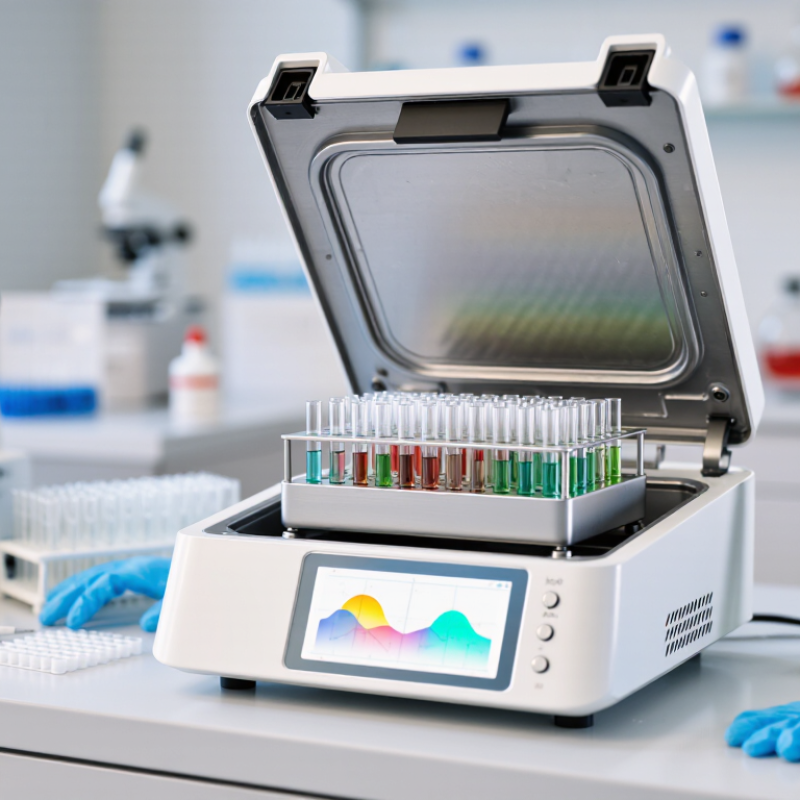
A PCR thermal cycler is a laboratory instrument that repeatedly changes temperature to copy selected DNA regions. It acts like a carefully timed metal chamber. Each cycle usually includes denaturation near 95°C, primer binding around 50–65°C, and extension near 72°C. These steps separate DNA strands, attach primers, and build new strands. After 25–40 cycles, the target sequence can increase from a few copies to millions. The exact yield depends on template quality, primer design, enzyme performance, and cycle settings.
The MIQE guidelines, published in Clinical Chemistry, recommend reporting cycle number, temperatures, hold times, and instrument settings. This guidance matters because two laboratories may use identical reagents but obtain different results. The machine controls heat precisely, yet it cannot correct poor sample preparation. A 2024 industry outlook from Grand View Research identifies thermal cycling as a central technology within the expanding PCR testing market. Its growth reflects wider use in research, clinical testing, food analysis, and environmental monitoring. Still, market growth does not guarantee reliable results. That point deserves attention.
Tips: Confirm the heated-lid temperature before running samples. Use a calibrated block when quantitative accuracy matters. Check that tubes sit firmly in the wells. Small gaps can change heat transfer. Keep a run record. Include positive and negative controls, following laboratory quality procedures. One practical caution: faster cycling is not always better. Shorter hold times may save minutes, but they can reduce amplification consistency. Even experienced users sometimes overlook evaporation at the tube edges. That mistake is easy to prevent.
How Temperature Cycling Enables PCR Amplification
What Is a PCR Thermal Cycler and How Does It Work?
How Temperature Cycling Enables PCR Amplification
A PCR thermal cycler controls temperature changes with precise timing. These repeated changes allow selected DNA regions to multiply. Each cycle contains three key stages: denaturation, annealing, and extension. During denaturation, heat separates the two DNA strands, usually near 94–98°C. The temperature then drops for primer annealing. Primers attach to matching sequences on the separated strands. Finally, extension occurs at a temperature suited to the DNA polymerase. The enzyme adds new nucleotides and creates complementary strands.
This sequence repeats for many cycles. Ideally, each cycle doubles the target DNA. Real reactions are less perfect. Reagents, sample purity, primer design, and temperature accuracy can reduce amplification efficiency. A reliable cycler must heat and cool evenly across its sample block. Even small temperature differences may produce uneven results between tubes. Modern instruments can also record fluorescence during cycling, helping users monitor amplification as it happens. Careful setup still matters more than automation.
Tips: Use clean tubes, calibrated pipettes, and validated cycling conditions. Confirm that the lid maintains proper pressure and prevents evaporation. Avoid copying a protocol without checking its polymerase, primer pair, and sample type. A short gradient test can reveal whether the annealing temperature needs adjustment. Keep detailed records. Small notes often explain large differences later.
The Step-by-Step PCR Thermal Cycling Process
What Is a PCR Thermal Cycler and How Does It Work?
The Step-by-Step PCR Thermal Cycling Process
A PCR thermal cycler changes temperature with precise timing. It guides repeated DNA copying inside small reaction tubes. Each tube contains template DNA, primers, nucleotides, a heat-stable polymerase, and a buffered solution. The machine presses the tubes against a heated block, then cools them quickly.
The process begins with initial denaturation, usually near 95°C. This separates double-stranded DNA into single strands. The cycler then lowers the temperature for annealing, often between 50°C and 65°C. Primers attach to matching target sequences during this brief stage. Poor primer design can cause unwanted products. That problem is easy to miss.
Next, the temperature rises to about 72°C for extension. The polymerase adds nucleotides from each primer, building new DNA strands. These three stages form one cycle. Most protocols repeat them 25 to 40 times. Each cycle can approximately double the target region, although real reactions are less perfect than diagrams suggest.
After cycling, some protocols use a final extension near 72°C. This gives incomplete strands more time to finish. The machine may then hold samples at a low temperature, commonly 4°C, until removal. In practice, small errors matter. An incorrectly closed tube, inaccurate pipetting, or unsuitable annealing temperature can weaken the result. Checking controls and reviewing the amplification curve remains essential for dependable interpretation.
Key Features and Applications of PCR Thermal Cyclers
What Is a PCR Thermal Cycler and How Does It Work?
A PCR thermal cycler repeatedly changes temperature to copy selected DNA regions. Its key feature is precise thermal control. Denaturation separates DNA strands, annealing lets primers bind, and extension creates new strands. Modern systems often include gradient heating, heated lids, adjustable ramp rates, and fluorescence detection for real-time PCR. A 2024 analysis by Grand View Research estimated the global PCR market at about US$11.9 billion in 2023, reflecting strong demand for reliable amplification and analysis tools.
Practical performance depends on more than temperature accuracy. A laboratory should examine uniformity across wells, calibration records, sample capacity, software traceability, and contamination-control design. The weak point is calibration drift. Even small temperature differences can affect weak targets or closely matched assays. In clinical testing, real-time fluorescence supports faster interpretation, while endpoint PCR remains useful for routine research and teaching. Applications include pathogen detection, genetic analysis, food safety, environmental monitoring, and pharmaceutical quality workflows. The World Health Organization’s 2024 laboratory guidance continues to emphasize validated molecular methods, documented controls, and trained operators. Automation helps, but it cannot repair poor sample preparation. That is easy to forget.