
A sealing ring may look like a simple loop, yet a wrong choice can leave oil on a pump housing, air hissing from a pneumatic line, or a maintenance team facing repeated downtime. For global buyers, material, profile, temperature, pressure, media compatibility, and installation conditions all matter. A low unit price is easy to compare. Service life is harder.
Robert K. Flitney, author of Seals and Sealing Handbook, emphasizes the engineering importance of matching seals to operating conditions. That principle helps buyers compare O-rings, X-rings, lip seals, bonded seals, and other common Sealing Rings by application rather than appearance. Parker Hannifin’s O-Ring Handbook provides practical technical guidance on elastomer selection and seal design. ISO 3601 also sets dimensional requirements for O-rings, giving purchasing teams a useful reference when checking specifications. These sources do not replace testing in the actual assembly.
Market context matters, too. Grand View Research’s industrial seals market report tracks demand across industries and regions, but broad market growth cannot tell a buyer which compound will resist a specific fluid. Details decide. A seal that performs well in clean water may swell in a process fluid; one that fits a static joint may wear quickly in motion. Even careful buyers sometimes overlook surface finish or storage conditions. That deserves a second check.
This guide compares the main sealing-ring types, typical applications, and selection trade-offs. It aims to help buyers ask better supplier questions, verify technical documents, and specify parts with fewer surprises.
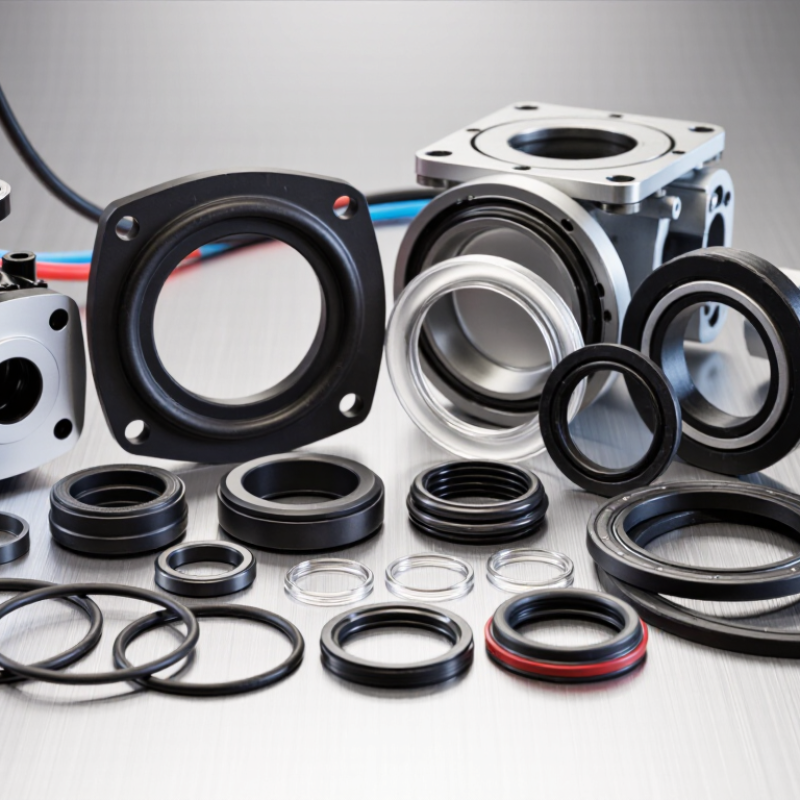
Common sealing rings address different leakage paths. An O-ring’s circular cross-section compresses inside a groove, creating a seal in static joints or moving equipment. ISO 3601-2:2016 specifies housing dimensions and tolerances for general-purpose O-ring applications. Engineering design handbooks commonly place static squeeze near 20–30%, while reciprocating seals often use roughly 10–20%. These are starting ranges, not universal limits; material, temperature, pressure, and motion all matter. Too much compression can accelerate wear.
Lip seals use a flexible edge that contacts a shaft, helping retain lubricant and resist dust. V-rings fit around rotating shafts and act as auxiliary barriers against water and debris. Flat gaskets spread compression across a broad flange, while backup rings support O-rings where pressure may force elastomer into a clearance gap. The choice can look obvious on a drawing, yet small groove details are easy to underestimate.
Tips: Check the groove dimensions, shaft finish, and fluid compatibility before choosing a ring. Check the groove. Then test under realistic pressure and motion; a seal that works on the bench may behave differently in service.
O-rings seal static joints and many reciprocating or rotating connections in pumps, valves, cylinders, and pipe fittings. Their circular cross-section compresses between two surfaces, creating a seal with few parts and little installation space. ISO 3601-1:2012 standardizes O-ring dimensions, covering inside diameters from 0.5 to 500 mm. That broad range helps buyers specify compatible sizes across equipment. Small details matter: a nick from a sharp housing edge can create a leak path. So can the wrong lubricant.
Material choice determines much of an O-ring’s performance. Nitrile rubber is commonly selected for oils and fuels; EPDM suits many water and weather-exposure applications; fluorocarbon elastomers can handle higher temperatures and some aggressive fluids. These are starting points, not guarantees. Check the fluid, temperature, pressure, and motion together, then confirm compatibility with a technical data sheet. ISO sizing does not establish chemical suitability.
O-rings are convenient, but not universal. Excessive pressure can push the ring into the clearance gap, while repeated motion may cause wear or twisting. Compression set can also reduce sealing force over time. Fit matters. Clean the groove, avoid sharp edges, and do not stretch the ring excessively during installation. A careful selection process helps, though real service conditions can still surprise you.
Lip seals and rotary shaft seals serve closely related roles in rotating equipment. A lip seal uses a flexible edge to contact the shaft and help retain lubricant. Many rotary shaft seals use this design, though the terms do not describe exactly the same thing. Selection depends on shaft speed, temperature, fluid type, and pressure. A seal suited to light oil may not tolerate abrasive grease or dry running. Small details matter.
Check the shaft diameter, surface finish, and runout before choosing a seal. Excessive runout can lift the sealing lip during rotation, causing leakage. Catalog dimensions are a useful starting point, but actual housings can differ slightly. During installation, protect the lip from sharp edges and press the seal evenly into its bore. The lip’s orientation depends on the pressure and fluid arrangement, so confirm the equipment drawing rather than guessing. A correct seal can still fail if the shaft is worn or installation is uneven.
Tips: Keep the shaft clean and lightly lubricated during fitting when the seal instructions allow it. Avoid stretching the lip over threads or keyways without a protective sleeve. If leakage returns, inspect the shaft surface and alignment before assuming the seal itself was defective.
Typical continuous service-temperature ranges for elastomers commonly used in lip seals and rotary shaft seals.
Ranges are indicative typical values in °C, not universal limits. Actual performance depends on the compound, media, pressure, speed, and operating conditions; check the seal manufacturer’s specifications for selection.
Gaskets, bonded seals, and backup rings solve different sealing problems. A gasket sits between two faces, such as a pump housing and its cover. Its success depends on suitable material, even compression, and clean, flat surfaces. A soft gasket may seal minor surface marks, but excessive tightening can crush it. Small details matter. Before choosing one, check temperature, fluid exposure, pressure, and how often the joint will be opened.
A bonded seal combines a metal washer with an elastomeric sealing lip. It is commonly used beneath a bolt head or around a threaded fitting, where the washer supports tightening and the rubber-like section seals the contact area. A backup ring works differently: it supports an O-ring and helps limit extrusion into a clearance gap under pressure. It is not usually the primary seal. Correct dimensions and material compatibility matter, yet installation alignment is easy to overlook. A specification can look complete on paper and still miss the real clearance in an assembled unit.
Tips: Match the seal to the joint, not just its diameter. Inspect grooves and mating faces for burrs, scratches, or trapped debris. Confirm pressure direction before selecting a backup ring. Keep installation surfaces clean, and avoid twisting elastomer seals. If a seal repeatedly fails, review the assembly conditions instead of simply choosing a harder material. That step is sometimes missed.
| Seal Type | Common Construction | How It Seals | Typical Applications | Key Advantages | Selection Considerations |
|---|---|---|---|---|---|
| Flat Sheet Gasket | Cut from compressed fiber, graphite, PTFE, rubber, or other gasket sheet materials. | Compresses between two stationary mating faces to fill surface irregularities. | Pipe flanges, pumps, tanks, heat exchangers, and general process equipment. | Available in many materials and shapes; suitable for a wide range of static joints. | Check the fluid, temperature, pressure, flange finish, bolt load, and chemical compatibility. |
| Spiral-Wound Gasket | Alternating layers of formed metal strip and soft filler, often with inner or outer rings. | Uses the resilience of the wound metal and compressible filler to maintain sealing contact between flanges. | Industrial piping and equipment flanges, particularly where operating conditions vary. | Resilient construction can accommodate some changes in temperature, pressure, and flange movement. | Confirm flange standards, winding and filler materials, ring configuration, and installation compression. |
| Ring-Type Joint (RTJ) Gasket | Solid metal ring manufactured to match a compatible grooved flange arrangement. | Deforms at the contact surfaces to form a metal-to-metal seal within the flange grooves. | Specified high-pressure piping and process connections designed for RTJ joints. | Provides a robust metal seal when used with correctly matched, undamaged components. | Match the ring profile and dimensions to the flange; inspect groove condition and follow specified installation practices. |
| Bonded Seal | Elastomer sealing element bonded to a metal washer, commonly in a circular configuration. | The elastomer compresses around a fastener or port while the metal washer limits over-compression. | Hydraulic and pneumatic fittings, threaded connections, plugs, and port assemblies. | Combines an elastomer sealing surface with a supporting washer in a compact assembly. | Check thread or port geometry, elastomer compatibility, temperature range, and tightening requirements. |
| Backup Ring | Separate anti-extrusion ring, commonly made from PTFE or another suitable polymer; used with an O-ring. | Supports the O-ring in its groove and helps prevent extrusion into the clearance gap under pressure. | Hydraulic cylinders, valves, and other dynamic or static O-ring applications with extrusion risk. | Can improve O-ring support where pressure, clearance, or operating conditions create extrusion concerns. | It is not normally a stand-alone seal; choose the profile, material, and placement to suit the O-ring groove and pressure direction. |
| O-Ring | Elastomer ring with a circular cross-section, installed in a designed groove. | Seals through controlled compression between mating surfaces or against a moving surface. | Static and dynamic seals in pumps, valves, cylinders, connectors, and machinery. | Compact, widely used, and available in many elastomer compounds and sizes. | Verify compound compatibility, temperature, pressure, groove dimensions, squeeze, and dynamic-service requirements. |
A sealing ring should be chosen for its working conditions, not just its shape. Identify the fluid, operating temperature, pressure, and whether parts move against the seal. An O-ring often suits a compact static joint, while a lip seal may fit a rotating shaft. For pressure that can push a ring out of its groove, a backup ring may help. Small details matter.
Material compatibility deserves careful checking. Oils, water, cleaning fluids, and outdoor exposure can affect elastomers differently. Compare the seal material with the exact fluid and temperature range, then check the pressure rating and expected service life. A ring that works in a cool test may harden or swell in a warmer machine. I would not rely on a general-purpose label alone.
Dimensions and installation can make a sound material choice fail. Measure the groove and mating surface, and check the seal’s cross-section, stretch, and compression. Sharp edges can nick a ring during fitting; a rough shaft can wear it quickly. Ask the supplier for a material data sheet and test the part under realistic conditions. Even then, the first choice may need revision—real operating cycles can expose problems that a drawing misses.